Working in Queen’s Gate SW7, my normal travel took me directly up the Piccadilly Line tube to King’s Cross, or later when I walked to work, in an arc through Paddington to South Kensington. I was an Islington Scouter, and went to various Methodist Churches locally, and some spare time activities took me in a sprinkling of locations within the borough. The only other regular journeys were to New Malden and Putney East – though with a good sense of direction, I also have a natural curiosity to explore the areas I arrive at, and soon got a good general geography of much of Central London; particularly the railway installations that were accessible. I also went further afield – to Southall, for instance, with a view to helping the preservation project there. Ashford, Cambridge and similar places within 50 miles.

LNWR 3020 “Cornwall” is pictured at Clapham Transport Museum, housed in the old bus garage there, on 29 May 1965 – a place I visited at least once as a boy. The exhibits eventually went to York as part of the Natinal Railway Museum. The blending of elegance with function of these locomotives of the past still engender admiration today, generations later. 650529A01-CLP-s3020-PARKD
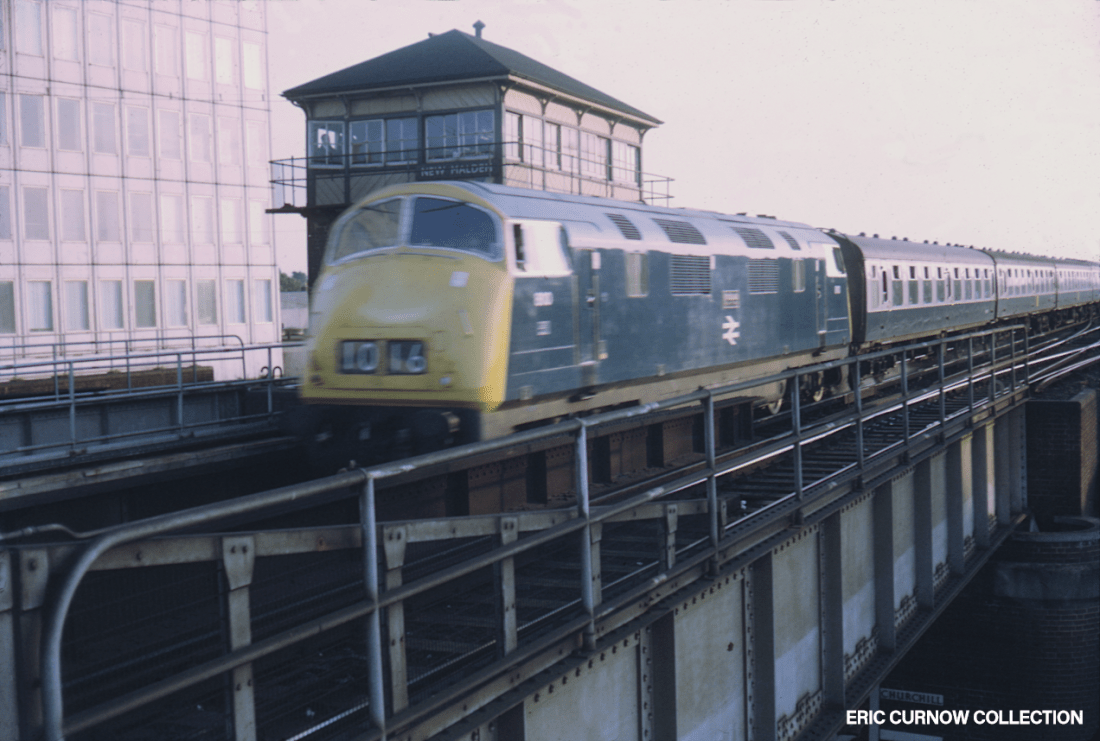
New Malden station, apparently in June 1970, with 810 Cockade passing through. My relations lived here, and I did stay with them in the early 70s, though only remember green emus as traction. My enduring recollection of this loco is in green with full yellow ends, and being nameplateless after reinstatement. The loco is on an Exeter St David’s to Waterloo service. 7006##A01-NEM–D810-PAS_U
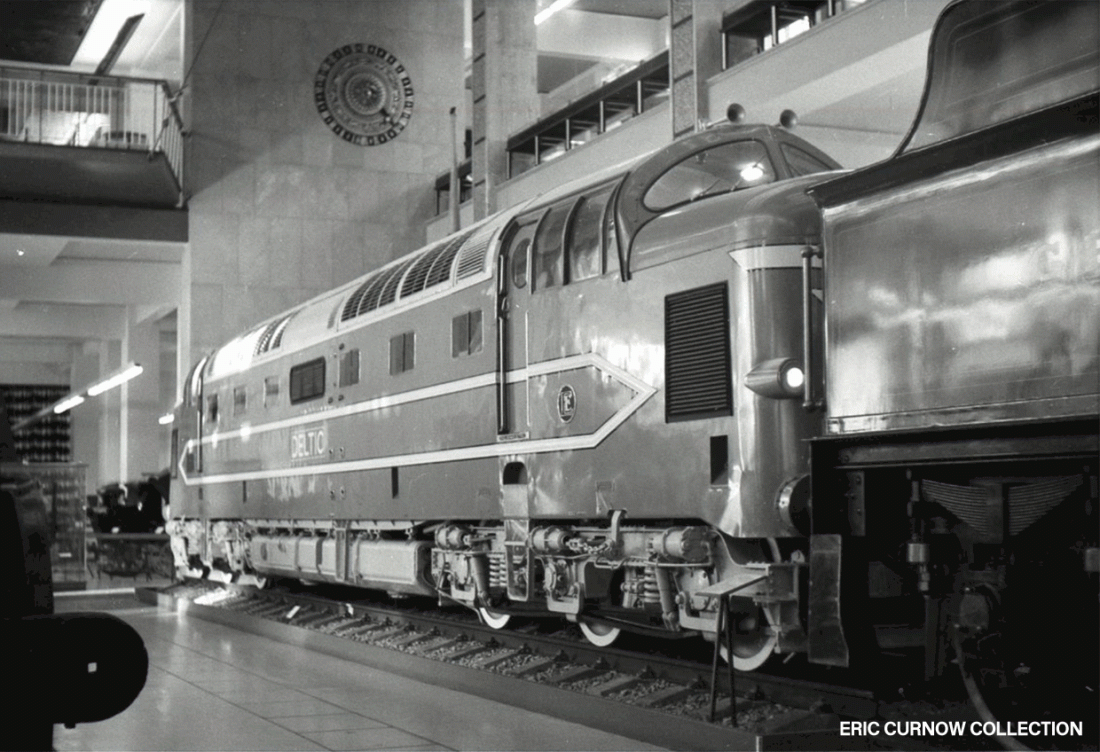
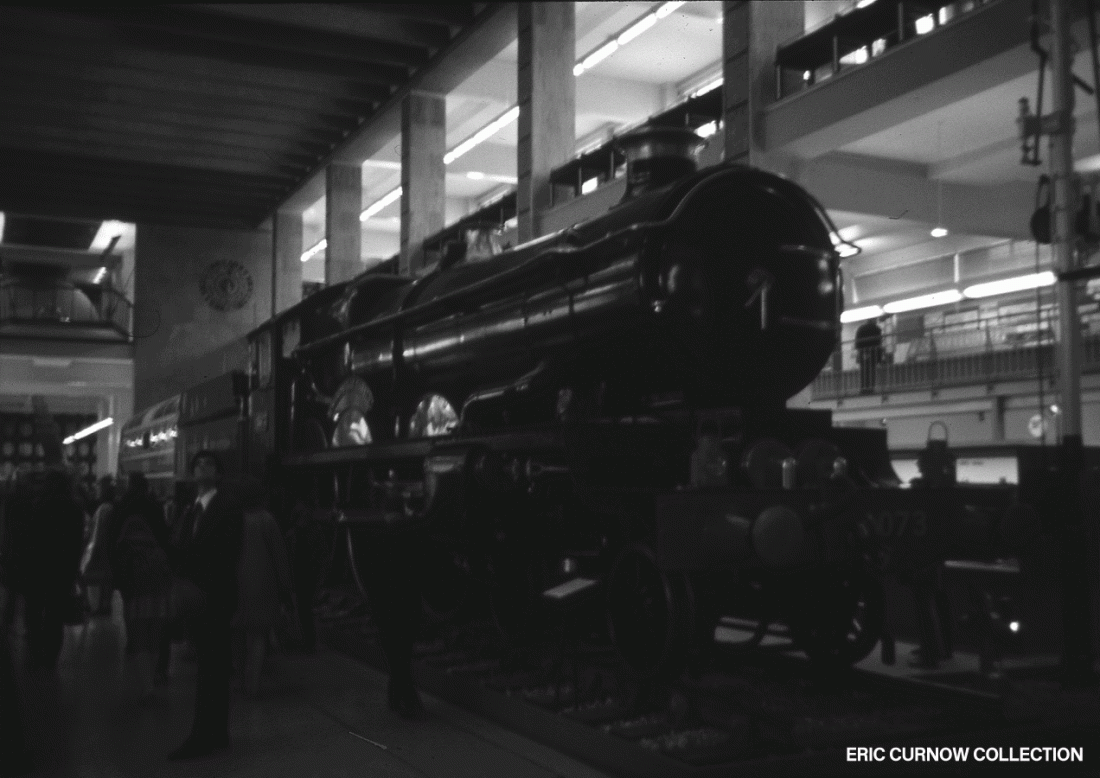
4073 “LODE STAR” is in a gallery at the South Kensington ‘Science Museum’ – just across the road from where I worked for about 25 years. As it, and ‘DELTIC’ behind, were so “artificial” in this environment, I only occasionally visited them. 720531A01-MUS-s4073-EXHBT
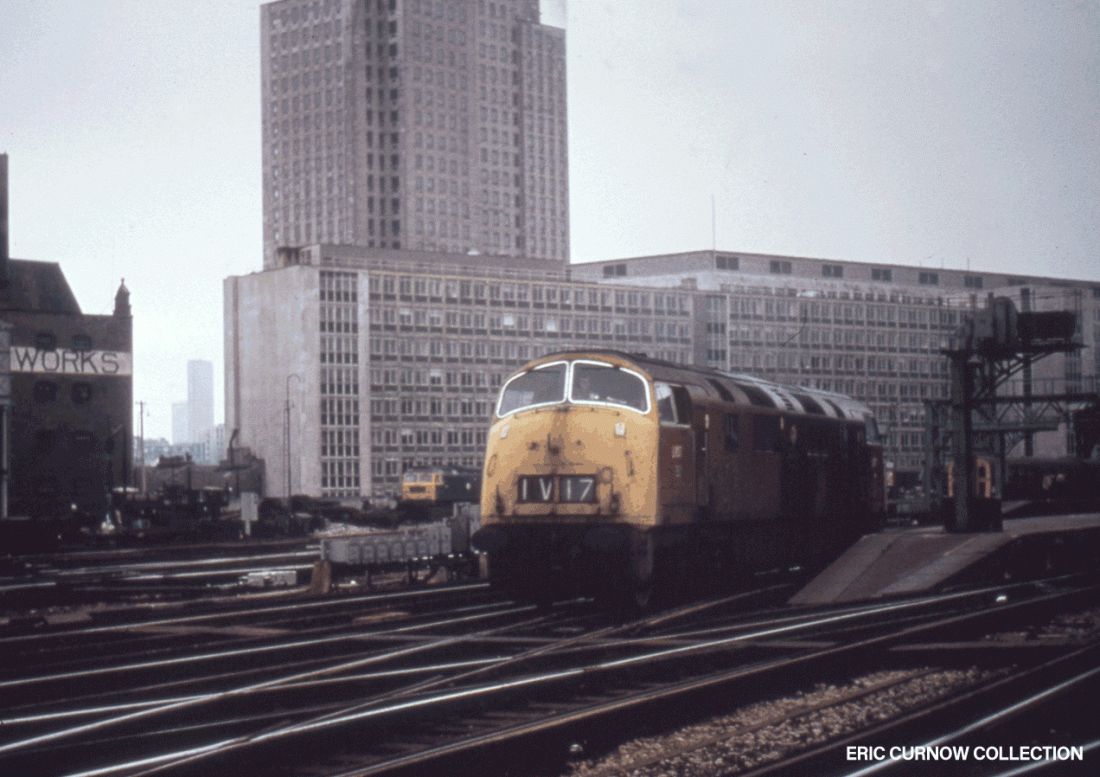
Office blocks dwarf D817 “FOXHOUND” as it runs free from its train at Waterloo to lie over in the sidings in the background until needed again. The second man is standing as it crosses the pointwork and the loco is a poor advertisement for BR in its tired maroon livery. 7109#AC01-WAT—D817-PARKD
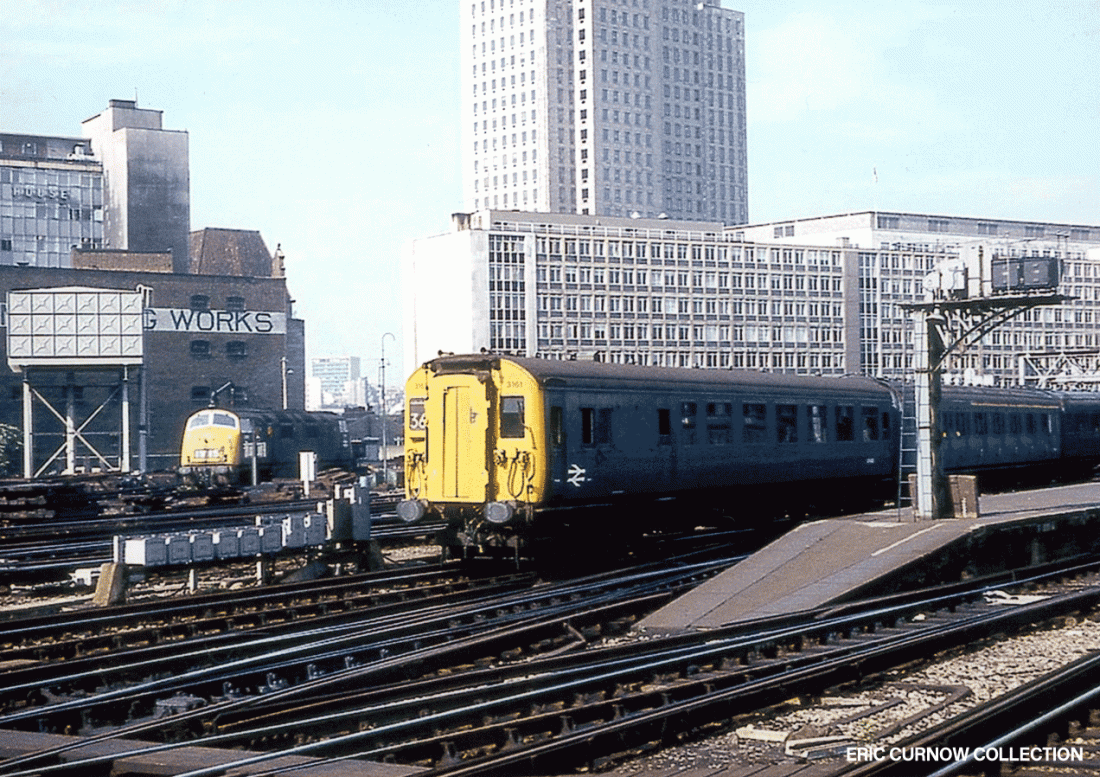
SR Unit 3161 leaves Waterloo as a ‘Warship’ in blue double-logo livery has a rest-over between turns to Exeter in the sidings behind. A steam-age water column and tank still exist, as steam power was in use on this region far longer than the WR. 6####BO01-WAT—D8##-PARKD
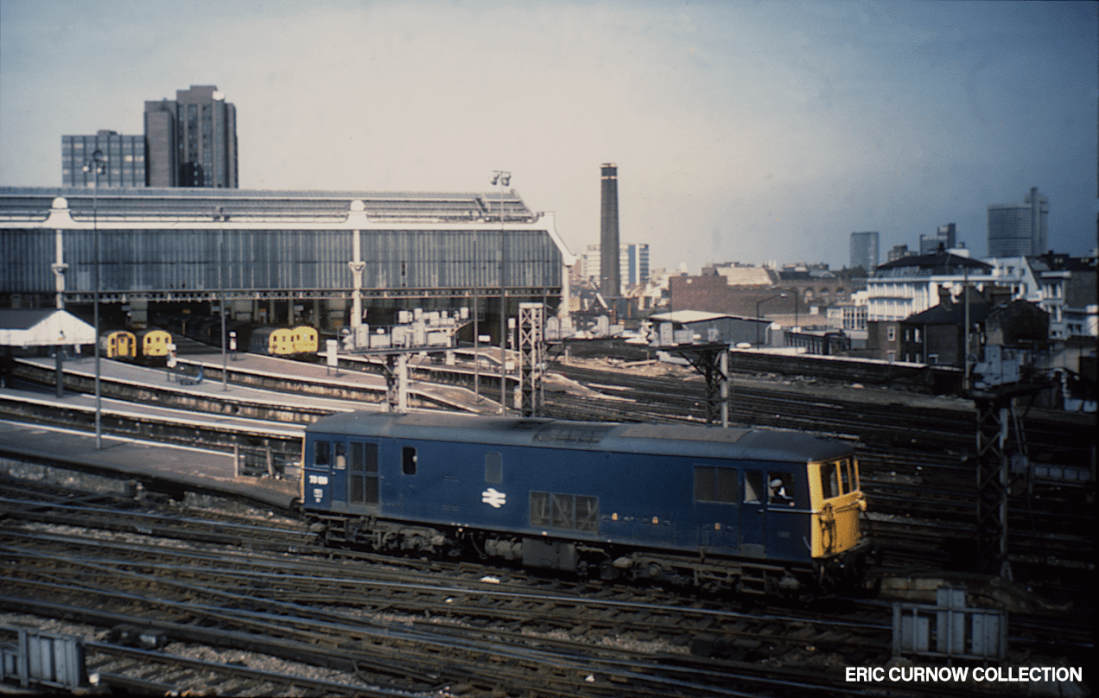
The second man guides electro-diesel 73126 as it reverses into Waterloo Station, light engine, in 1980 – able to work from third rail electrification where power was available, or run off a small diesel engine where “off grid”. In the background are suburban units and a mainline emu, with platforms separated by large clusters of trackwork and multiple signals on various gantries. 80###AJ01-WAT-73126-LIGHT

Two-car suburban unit 5759 – a class of emu I frequently commuted on – enters Waterloo Station, paired with another set in the newer blue and grey paint finish. In the background is a 508XXX unit – a type I became monotonously familiar with, and in the foreground curved girders reinforcing the bridge are prominent between the tracks. 8####AV01-WAT–U5759-PAS_U
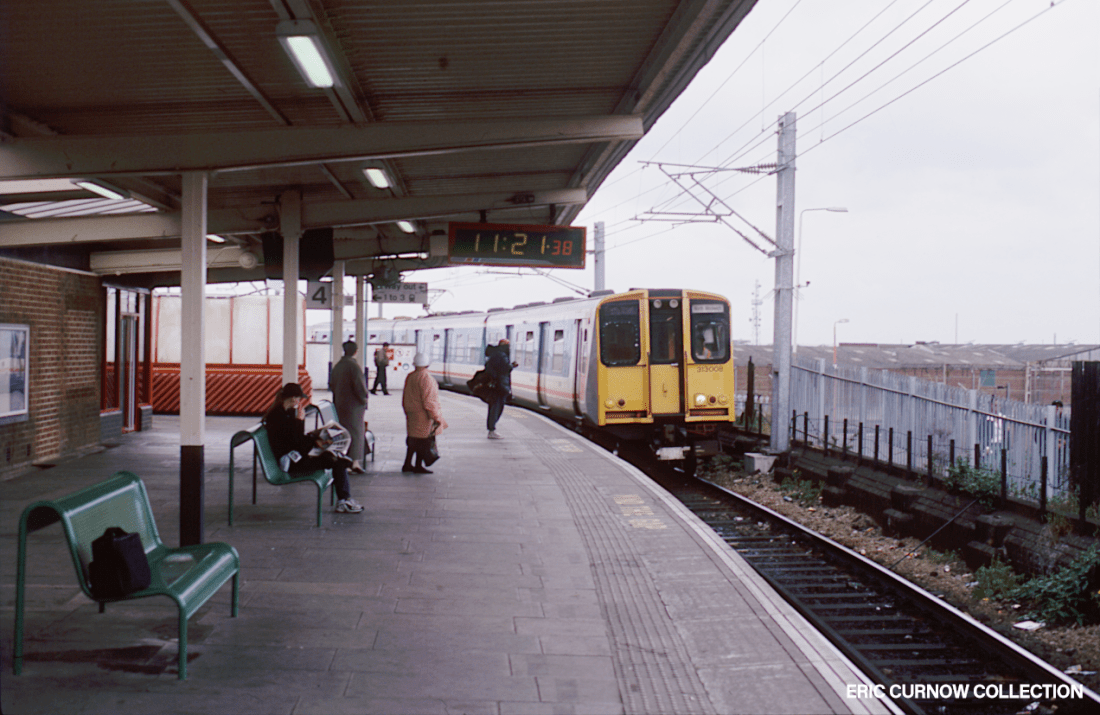
4-car EMU 313008 in Network South East livery runs off the bridge over the main lines out of Euston at Willesden Junction on its way East to Broad Street and Woolwich among locations. Although I passed beneath on quite a few occasions, I only took this line about half a dozen times, from Camden Road just north of where I lived, to look at the depot just south. 980512A01-WIJ-3~008-PAS_I
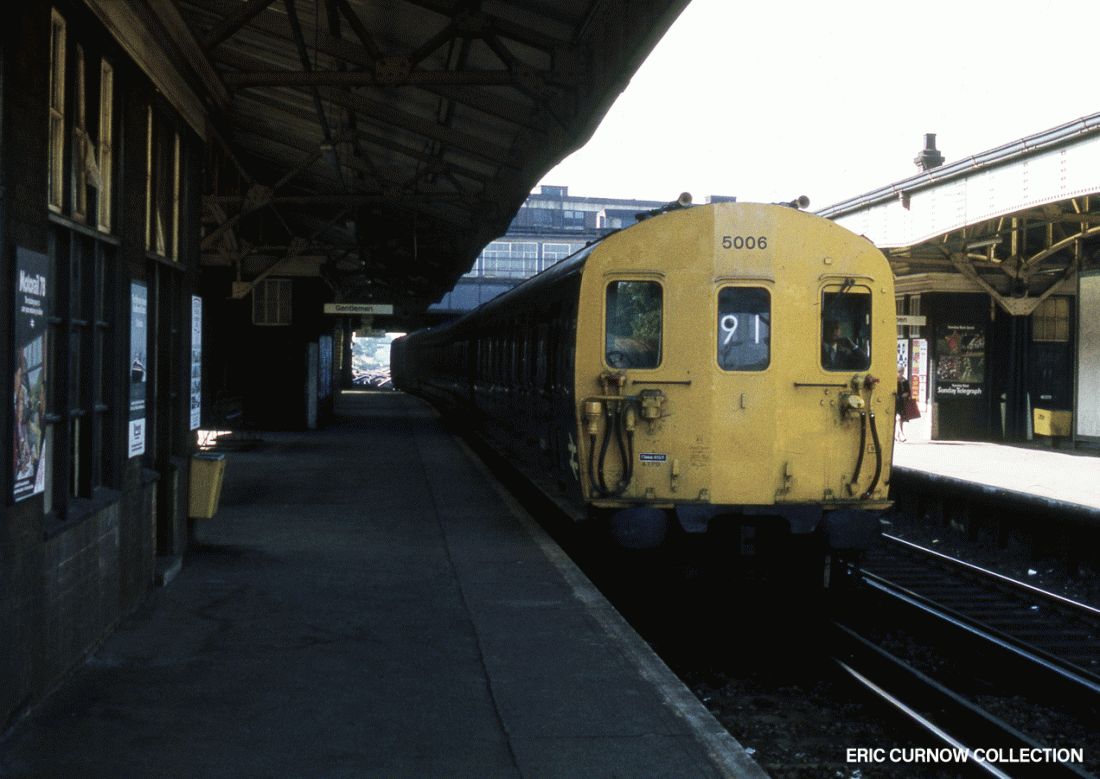
Class 415 EMU 5006 runs through Wimbledon in 1978 with a Waterloo-bound train – no doubt accompanied by tannoy calls to stand clear from the platform edge. Judging by the sun, this seems to have been taken at midday when few passengers are about – beyond the bridge and tracks curving left is the engineers’ yard, that saw quite a bit of activity at this time. 78###AF01-WIM-u5006-PAS_D

Marylebone Depot, just north of the station on the east side – though I seldom visited as it only serviced DMUs, and usually just caught glimpses of it from the overbridge nearby. To the right is the water tower and on the left hand side are expensive flats of St John’s Wood – this is the area of Lords’ cricket ground and the Beatles “Abbey Road’ record cover. 8####BU01-MYB-DEPOT-VI__N
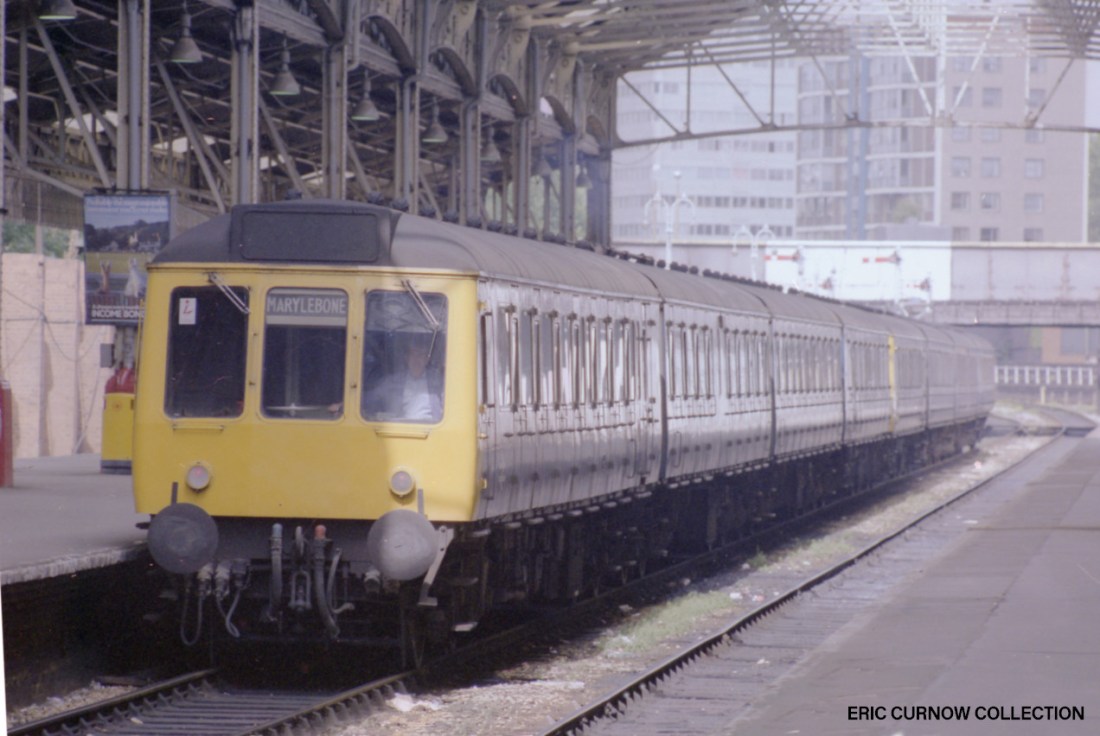
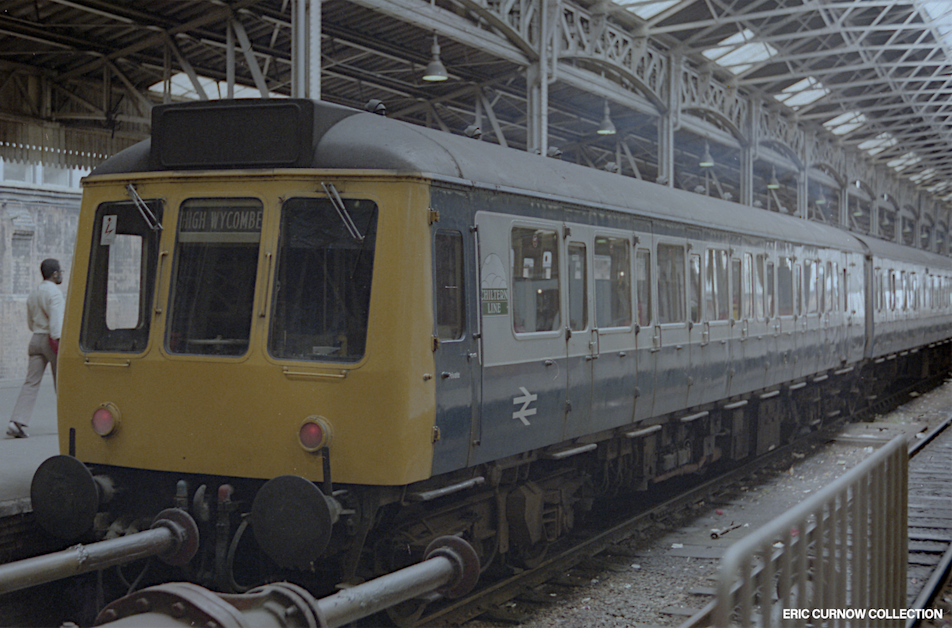
DMU sets at Marylebone after arrival from Aylesbury in the days before Unit numbers were added to their front ends. Upper quadrant signals are visible in the background, and hugh blocks of flats have sprung up alongside the track as St John’s Wood is a sought after area in which to live.The lower image has a ‘High Wycombe’ destination board, and a Chiltern Rail transfer on its side. 7####HH01-MYB-6XDMU-PAS_U
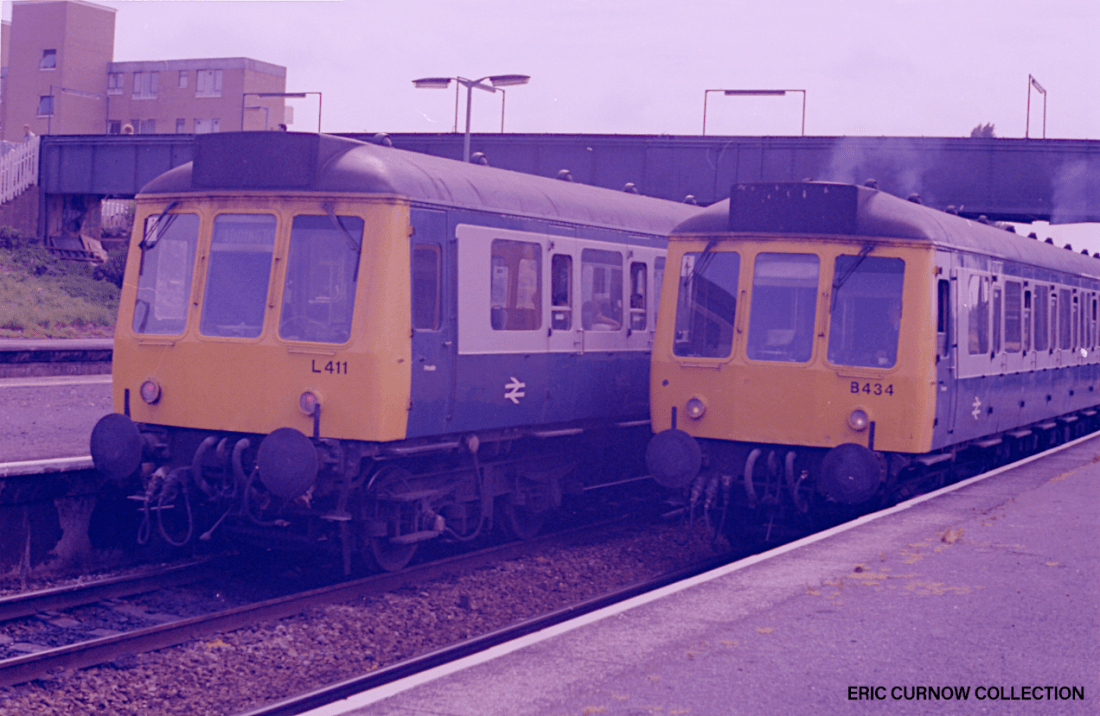
L411 (Paddington-bound) and B434 pass on opposite platforms of a suburban station on a warm day – the front end L representing ‘London’ and the ‘B’ Bristol area allocations. Judging by the flaking paint from the plywood covering the destination panel of the nearest DMU, it has been some time since it was covered over, and the small BR logos suggest the late 70s. 7####HH04-UNK-2XDMU-PASGR
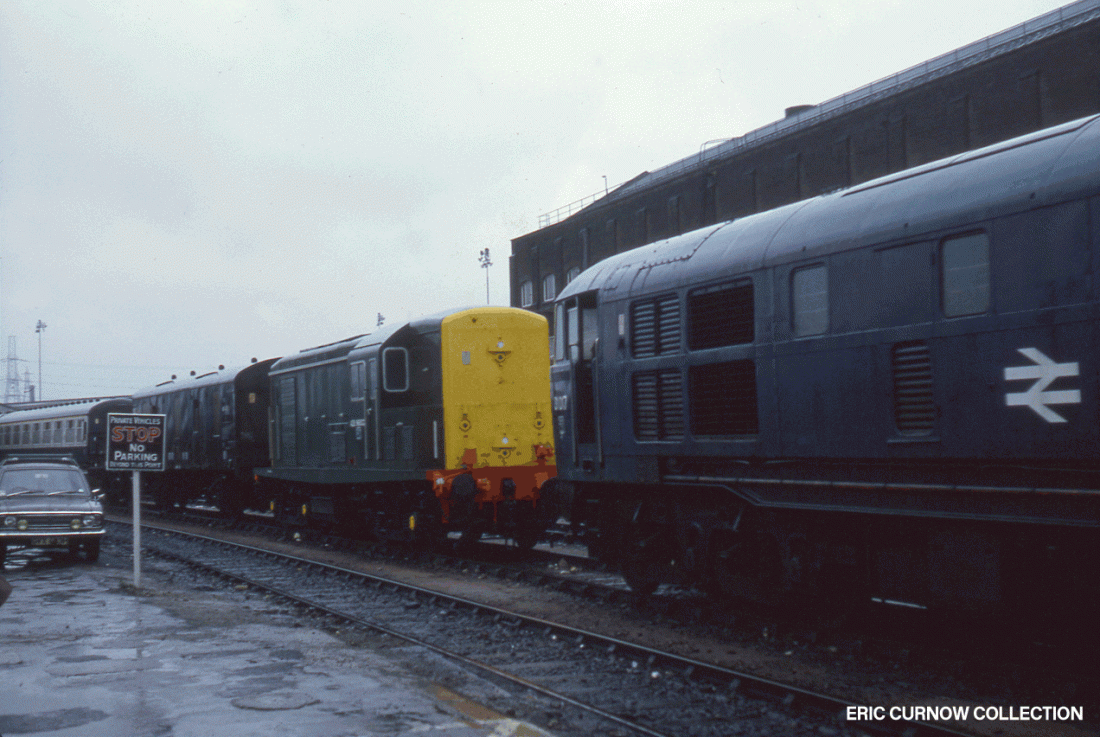
One of the redundant Class 15s produced by British Thompson Houston, painted in green livery and given an ADB number, is now a carriage heating unit at Stratford. I only managed to see one of these, and two more at Colchester before they were withdrawn. 80###AC01-SFD-ADB15-PARKD
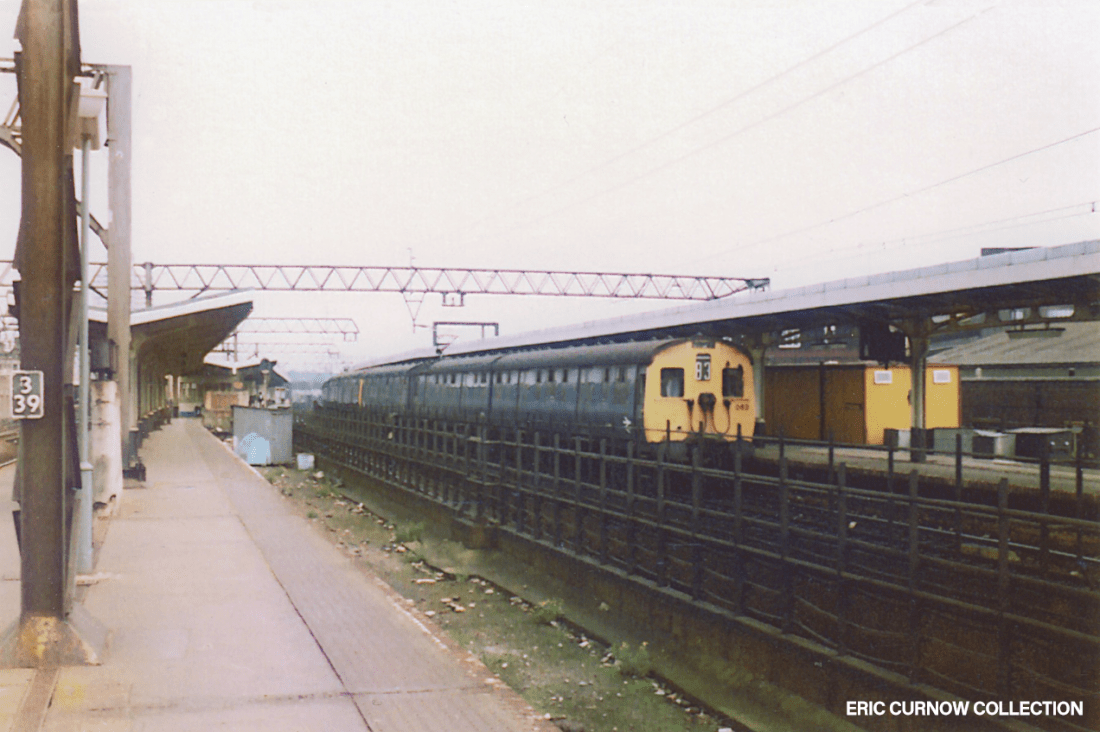
On a bit of a grey day, EMUs 083, 014 and 042 pause at Stratford with the 11.37 service from Gidea Park to Liverpool Street. The front ends of these units always seemed unnecessarily ugly to me – too functional and without finesse – and are the enduring memory of my first visits to Stratford station, en route to the depot and vantage points around the area. 800927A01-SFD-3XEMU-PAS_U

Although it might be expected that this is D1000 “WESTERN ENTERPRISE”, it seems more likely to be D1071 ‘WESTERN RENOWN’ passing through Taplow station towards the end of its working life. When head codes were discontinued, few accurately recorded the loco’s bodyside number. 7####BM01-TAP-D1071-PAS_D
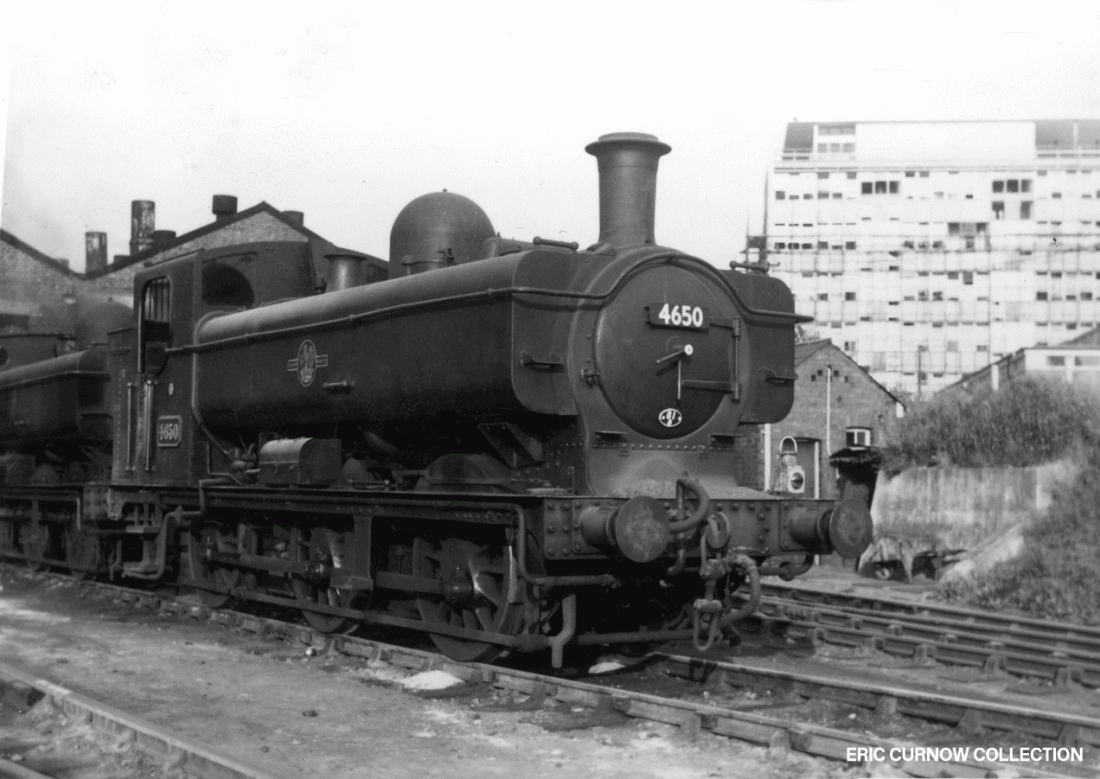
The block of modern flats overlooking Slough shed makes a striking contrast of the quaintly old and the modern. Pannier Tank 4650 is parked with a colleague and in pretty good external condition – the contrast of white paint used suggesting a recent repaint. 590531A01-SLO-s4650-PARKD

A “Railmotor” leaves Southall Station in the London direction, about to pass Southall East Signal Box at the entrance to the depot. In the distance beyond is the castellated Water Tower, and the Gas Holder, and in the foreground, the branch to Brentford Docks. 80###AG01-STL-STATN-BLDNG
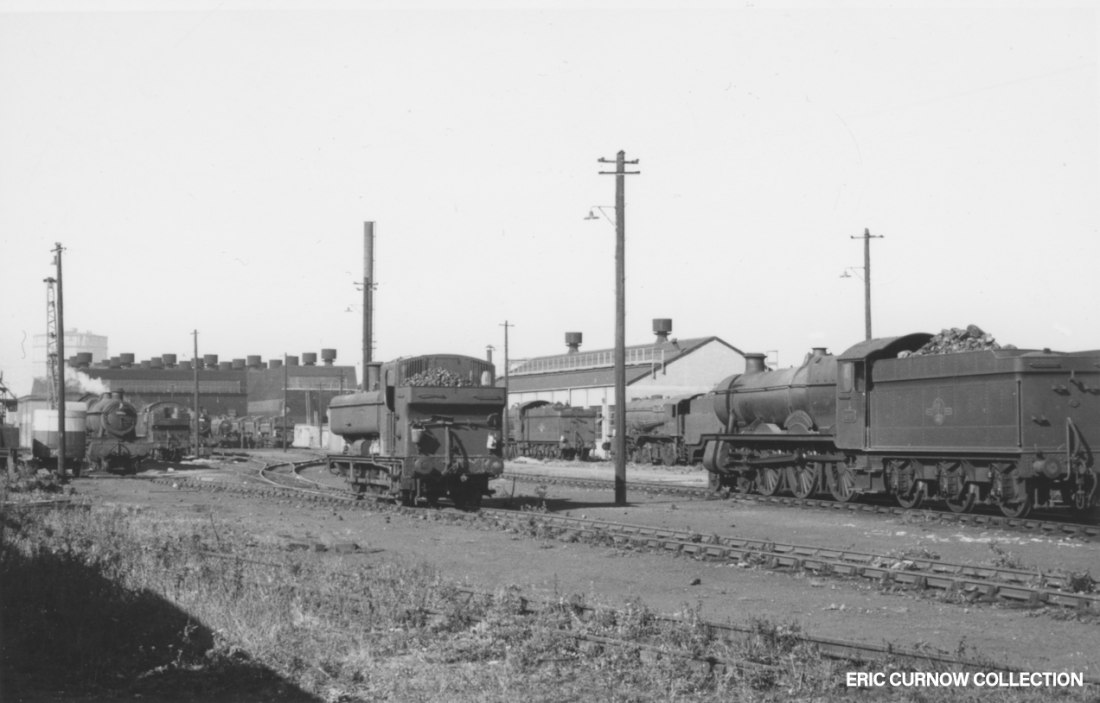
An 0-6-0 Pannier Tank and a ‘Hall’ class are in the forefront of a picture of the back of Southall Engine Shed in October 1959 – a large number of ex-GWR locomotives are in view. The large ventilators on the many roofs of the depot were most distinctive of this location, as was the huge Gas Holder in the far background. Photo: Photomatic Ltd. 59####A01-STL-LOCOS-PARKD

Before the area was heavily encroached by industrial units, a green-liveried hymek heads west in the Southall area with a train of Mk1 maroon finished coaches. Before it is a scrub field, edged with heavy-duty fencing – to the right, an area has been cordoned off right up to the trackside. The loco wears recently-applied ‘Overhead live wire’ signs. 6###HRA01-STL-D7###-PAS_D

The high screen of trees mask much of the former station yard at Marlow, now short-sightedly in private hands, and gives the railway little room for future expansion as the utility is “squeezed in” by domestic development. Traditional spearpoint railings flank the other side of the track as DMU set L130 trundles in along the single track access. 77###AD01-MLW–L130-PAS_O
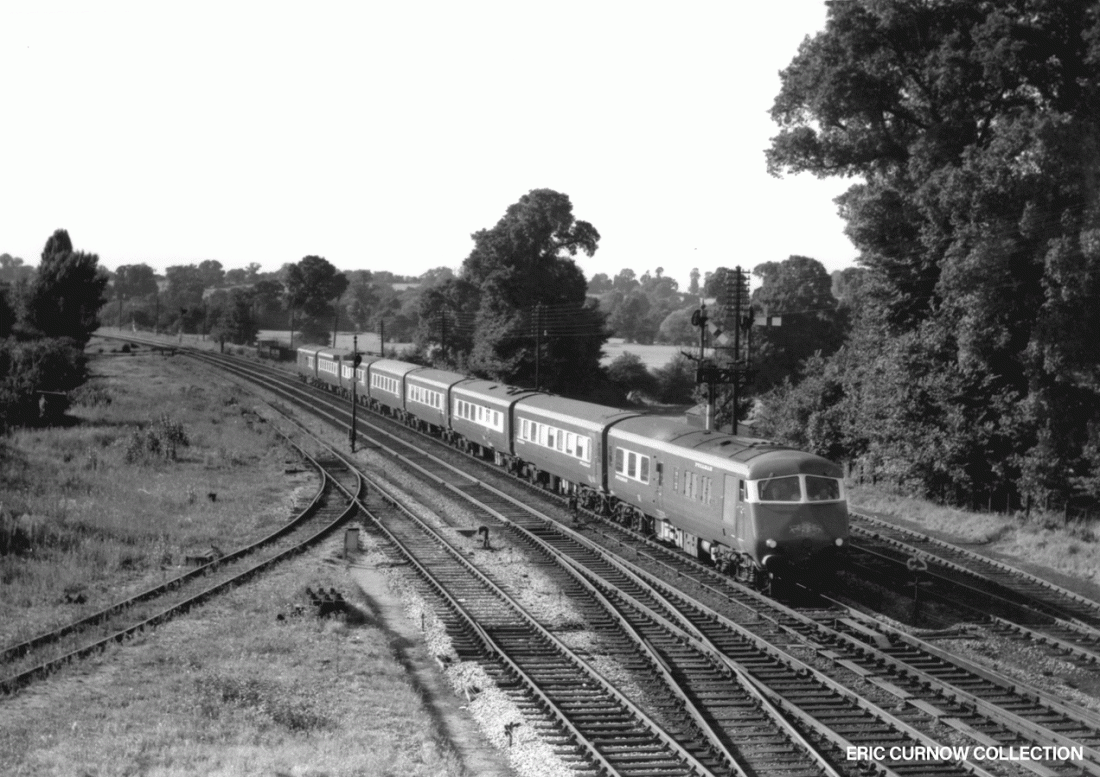
A bracket signal falls to permit an 8-car “Blue Pullman” to pass, slowing for West Ruislip Station, from the Denham direction. Behind it are huge trees and open countryside, and before are a few overgrown tracks – the remnants of a once much larger railway yard. 7####DL01-UNK-PULMN-PASGR

Platform end spotters at Clapham Junction watch the arrival of D832 “ONSLAUGHT” from Waterloo, hauling SR stock on a westbound passenger service. A hand barrow and ‘Do not cross the lines’ sign are beside them, and flat-topped roofed signal box ‘Clapham Junction B’ is behind the train. 6###CM04-CJN—D812-PAS_D

Marylebone Station façade in 1980. This was the terminus for services to Aylesbury when I lived there, and DMUs were pretty-well the only traffic on the route. Later, I walked close by on weekdays, backwards and forwards to work, for several years, but closer to the ex-BRB Headquarters at 222 Mayylebone Road, and rarely visited the unenticing station behind it. 80###AI02-MYB-S_BLG-VI__N
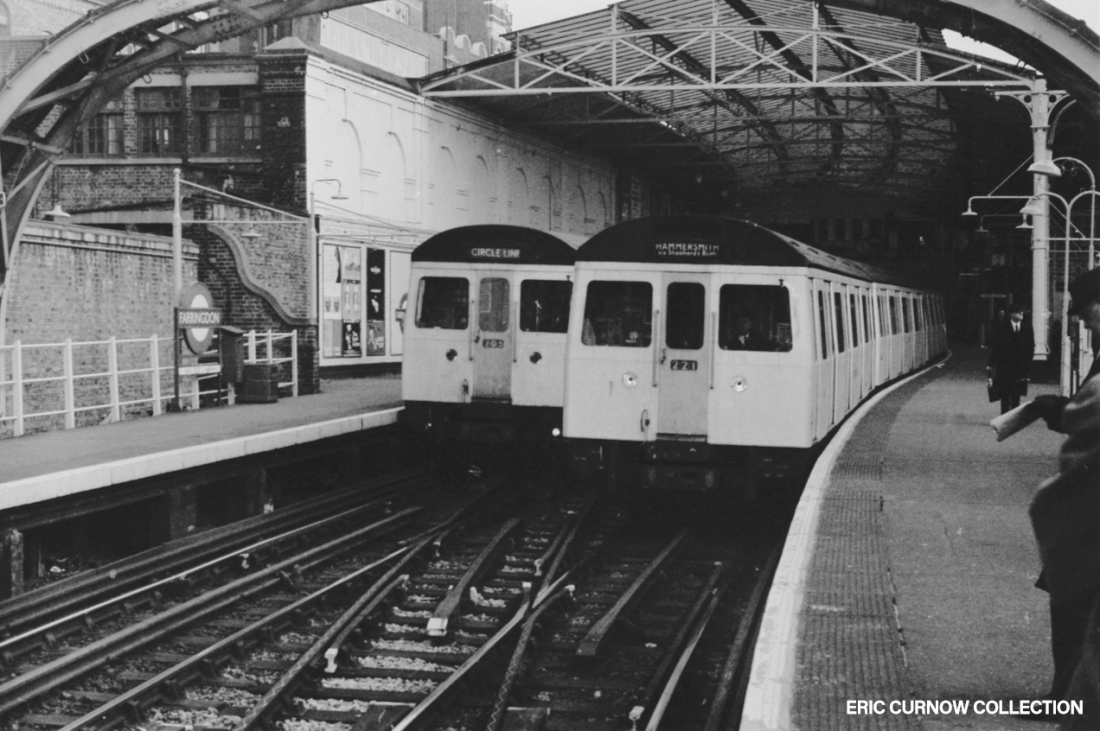
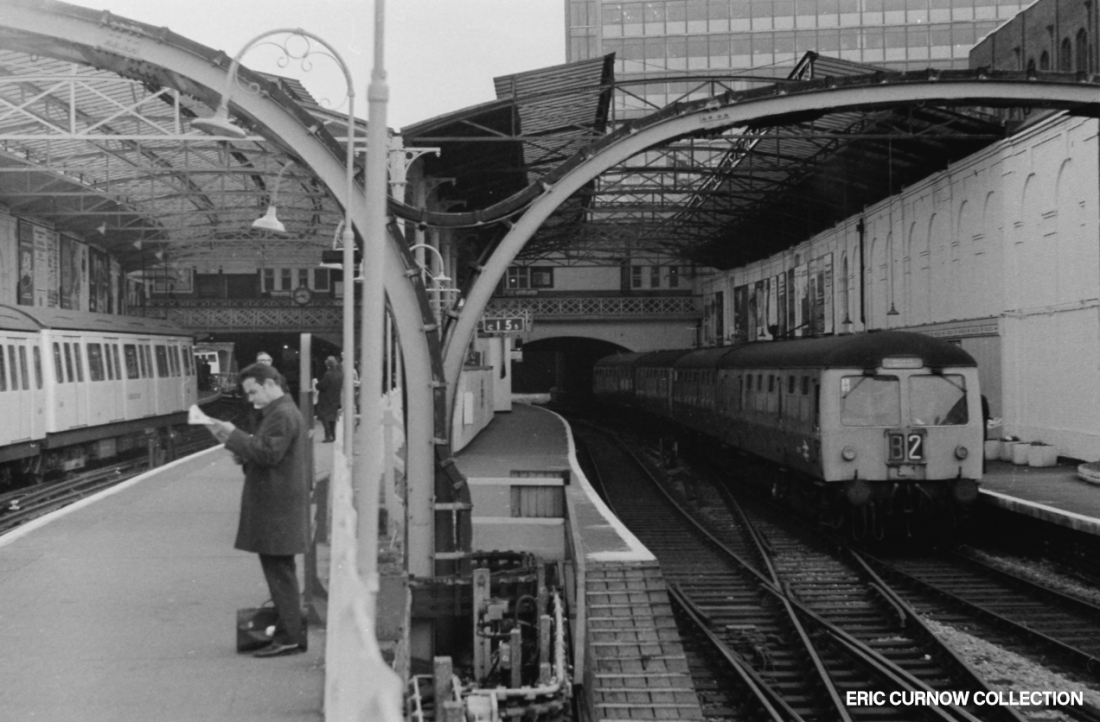
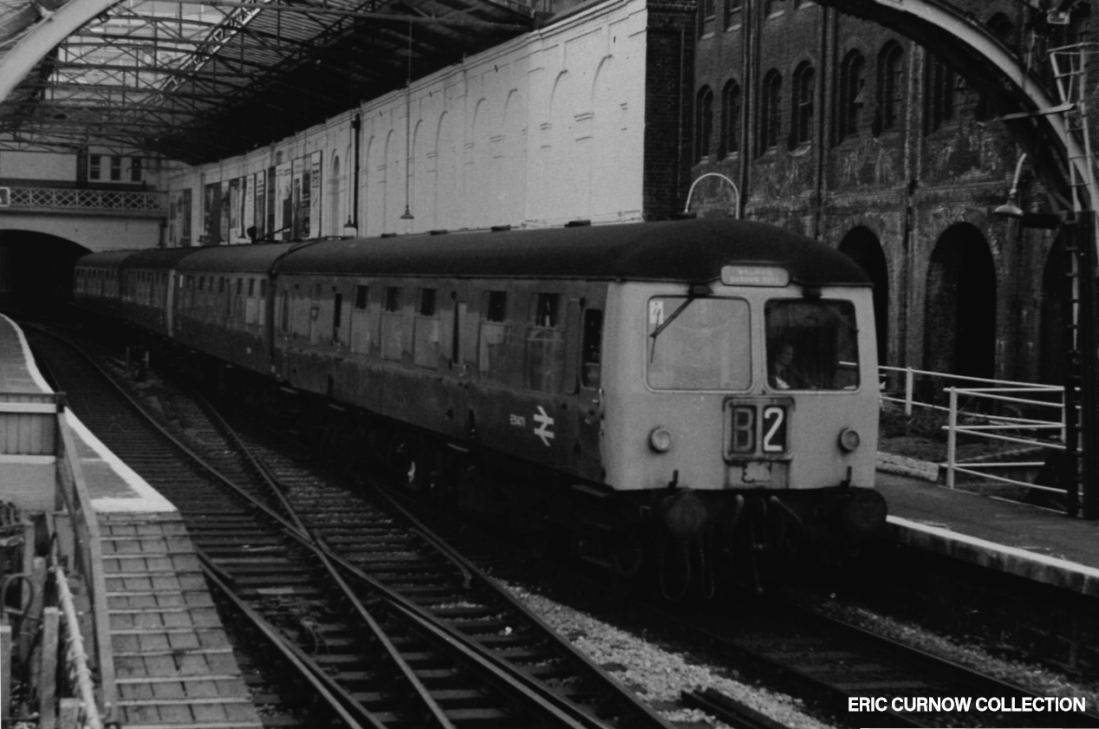

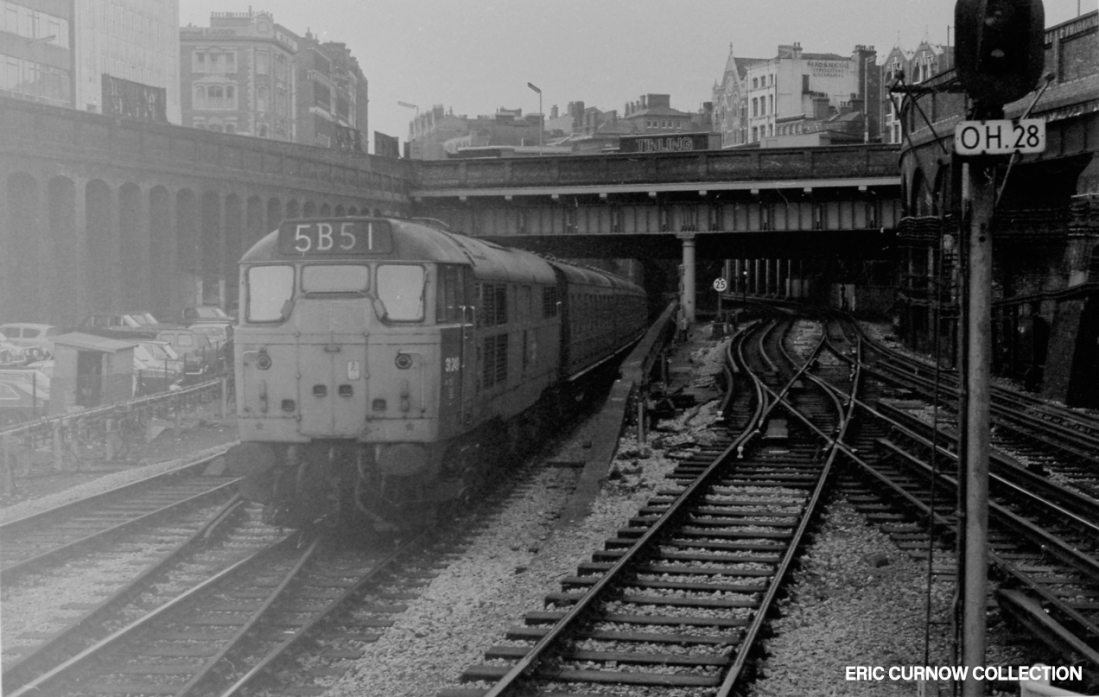
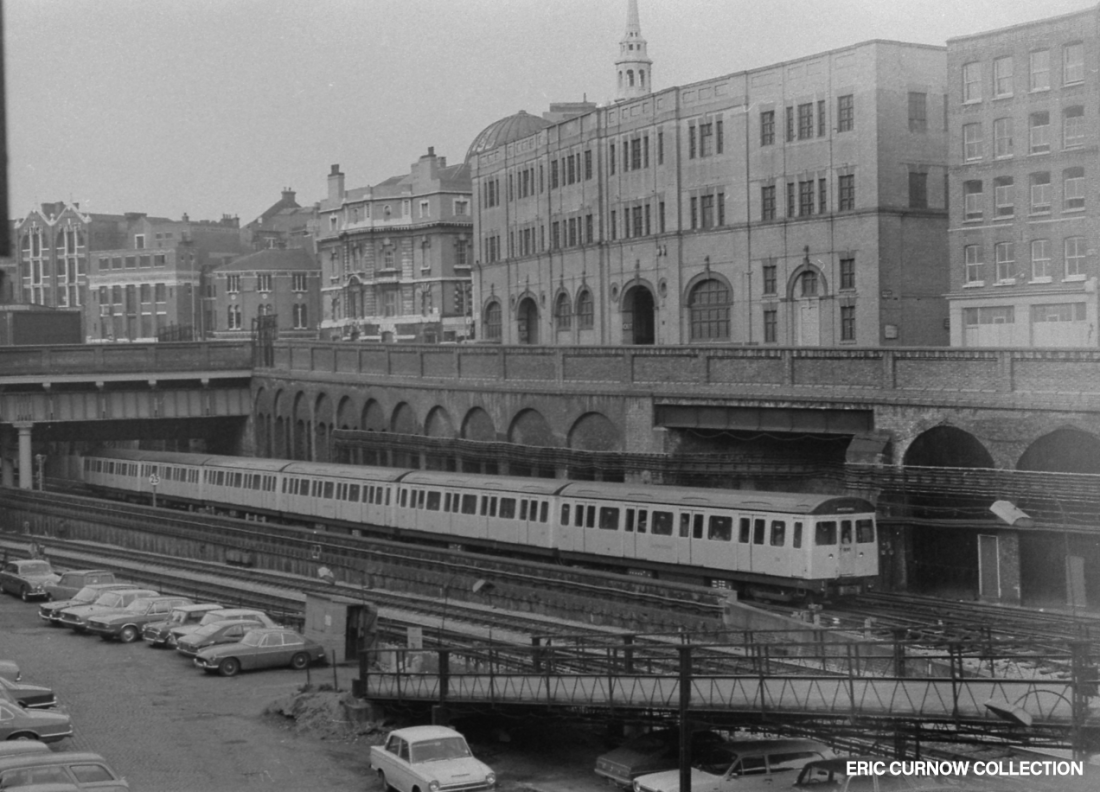
London Transport Underground and “Widened Line” traffic passes through Farringdon station in the late 1960s. One of the ‘Cravens’ DMUs has ‘Welwyn Garden City’ in its destination blind, and 31429 is identifiable. The goods yard beside the station has been converted to a car park, although a refuge siding remains. A lot of underground tunneling to the city area remained nearby, too.

This class of unit is my enduring memory of my first visit to Chingford – unit 016 taking the curve with a Liverpool Street Service at a station I was familiar with, but cannot now place. Seen through the windows are the huge sprung seats that were far more comfortable than today’s lighter, ergonomic offerings. 78###AE01-UNK-3XEMU-PARKD
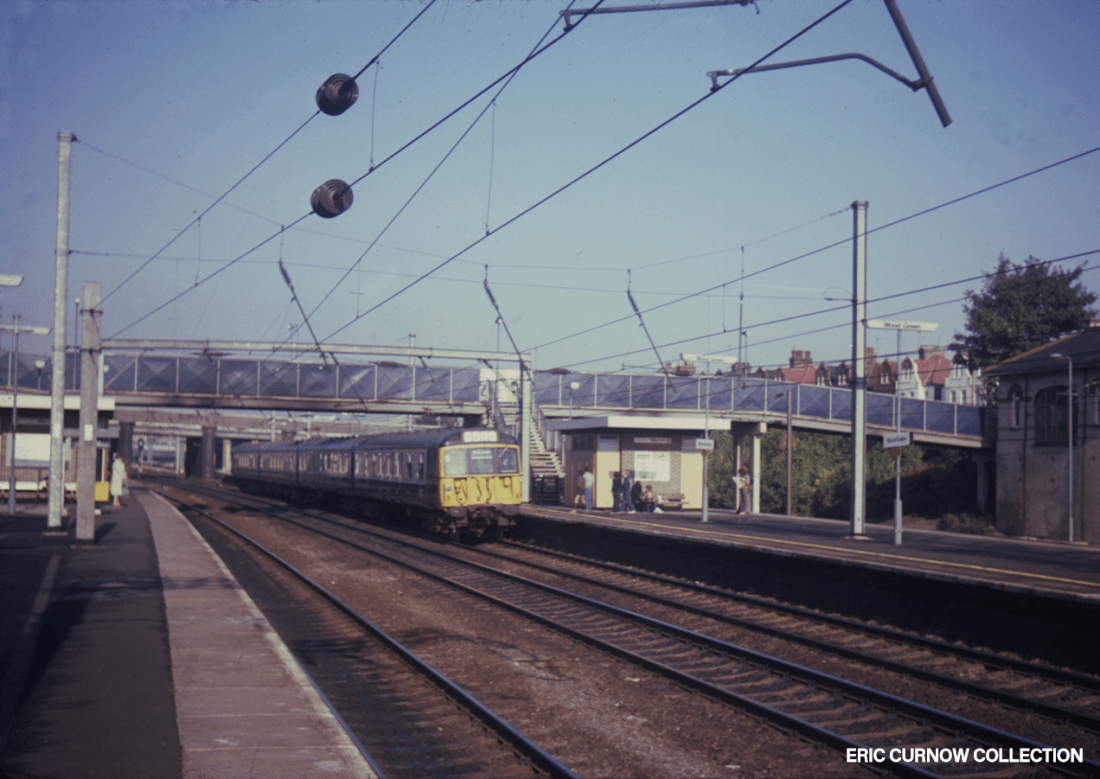
A 312 unit on a run in to Kings Cross slows to a stop at Wood Green station on 21st October 1978. Beyond the left edge of the picture is the huge hill surmounted by ‘Ally Pally’, and through the bridge behind the train is Bounds Green Depot. Behind the photographer is the staight track stretch that Deltics used to noisily climb – a tremendous sound! 781021A01-WGN-u312#-PAS_D
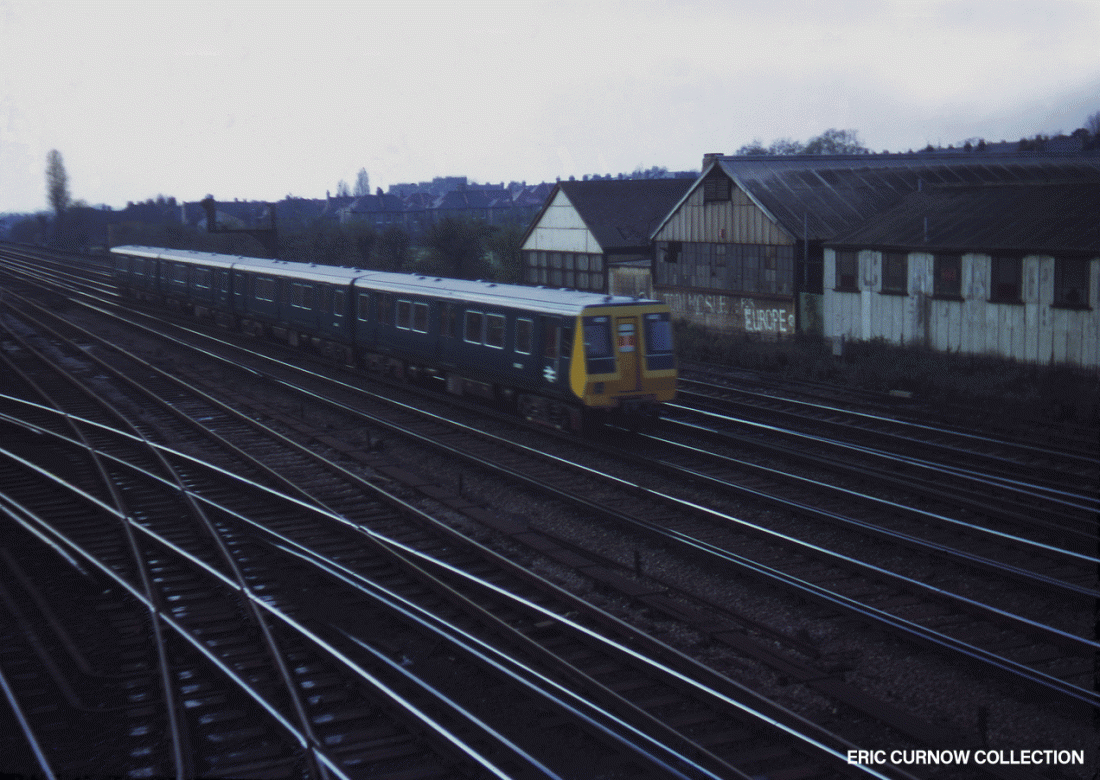
SR 4PEP EMU No. 4001 passes Wimbledon ‘C’ signal box, west of Wimbledon station on Sunday 8th November 1970 with a down special test train (Headcode 54), on the down fast. To the left are the tracks towards Mitcham, with the Engineers’ Yard behind and just out of sight. In my opinion, the front ends of this prototype set far surpassed that of the production versions. 701108A01-WIM-u4001-SPL_U
 I rarely used the ‘North London Line’ – the curving line from Richmond to Broad Street station – though it ran through this run-down station, Camden Road, a short distance north of Camden’s centre. This westbound service has a red buffer beam that I’d never noticed on such a Unit, and is across the platform from the freight line, that was far more interesting! 83###AA01-CMD–U186-PAS_W
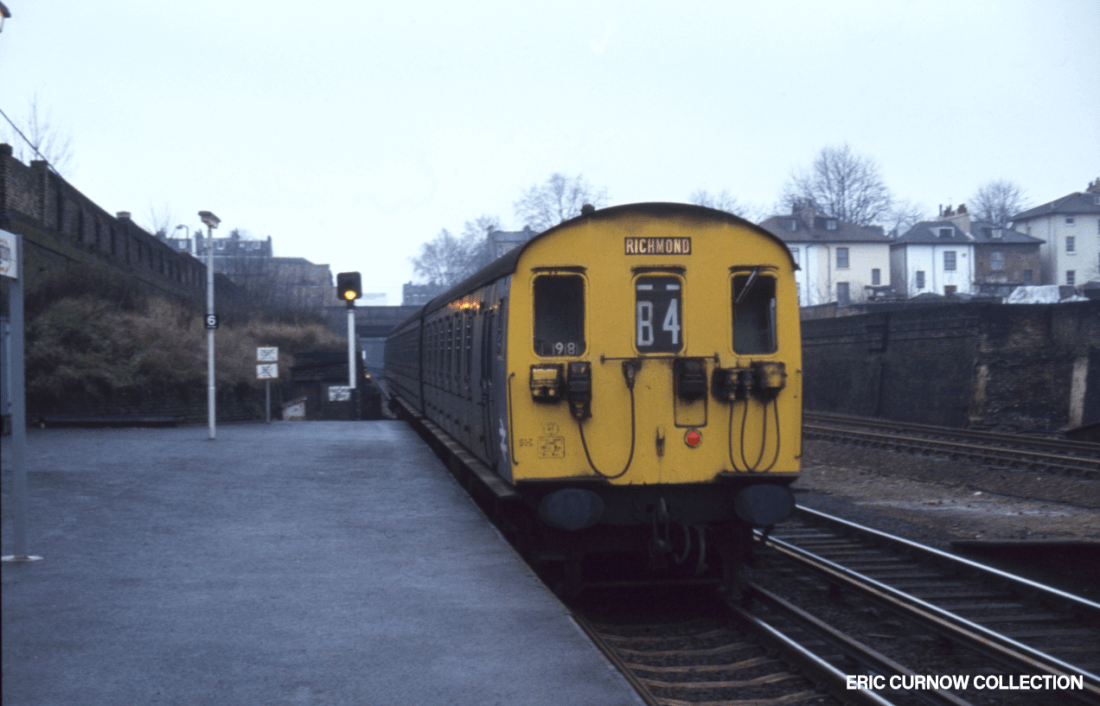
Highbury & Islington Station was a regular transit point of mine – both the Underground, and looking over the BR line from any clear vantage as I passed alongside – particularly in order to see inter-regional freight workings along the North London Line on the far side. A standard design 3-Car EMU passes through west en route to Richmond in 1979. 79###AF01-HHY-EMUX3-PAS_O
 The Eric Curnow Collection